How do professional balloon engineers protect outdoor oceanfront balloon decor from coastal winds, salt air, and California heat expansion in Malibu and Santa Monica?
Outdoor oceanfront balloon installations are engineered using heavy-duty steel baseplate ballasts (weighing 30 to 50 lbs per anchor leg), flexible low-wind drag aluminum conduit framing, and double-stuffed 100% natural latex balloons. To counteract Charles's Law thermal gas expansion under direct 85°F+ California sunlight, balloons are under-inflated by 10% to 15%. UV anti-oxidant coatings and double-layering protect latex elasticity against salt spray, preventing popping and preserving structural integrity throughout outdoor estate events along Malibu and Santa Monica coastlines.
1. The Physics & Microclimates of Coastal Southern California
Southern California is world-renowned for its idyllic outdoor climate, rendering oceanfront estates in Malibu, cliffside mansions in Pacific Palisades, and terrace venues in Santa Monica premiere locations for weddings, galas, and milestone celebrations. However, executing large-scale balloon architecture outdoors along the Pacific Coast presents unique environmental and physical challenges.
Unlike controlled indoor ballrooms, outdoor coastal installations are exposed to three destructive environmental forces: sustained ocean wind gusts, rapid solar thermal expansion, and coastal UV oxidation combined with salt-air humidity. At The LA Balloonist, based in Burbank, CA, our structural engineers treat outdoor installation as a precise exercise in mechanical physics and latex chemistry. In this 3,500-word masterclass guide, we detail wind drag calculations, steel ballast weighting, thermal gas expansion formulas, and UV protection protocols required to install flawless balloon decor along the Southern California coastline.
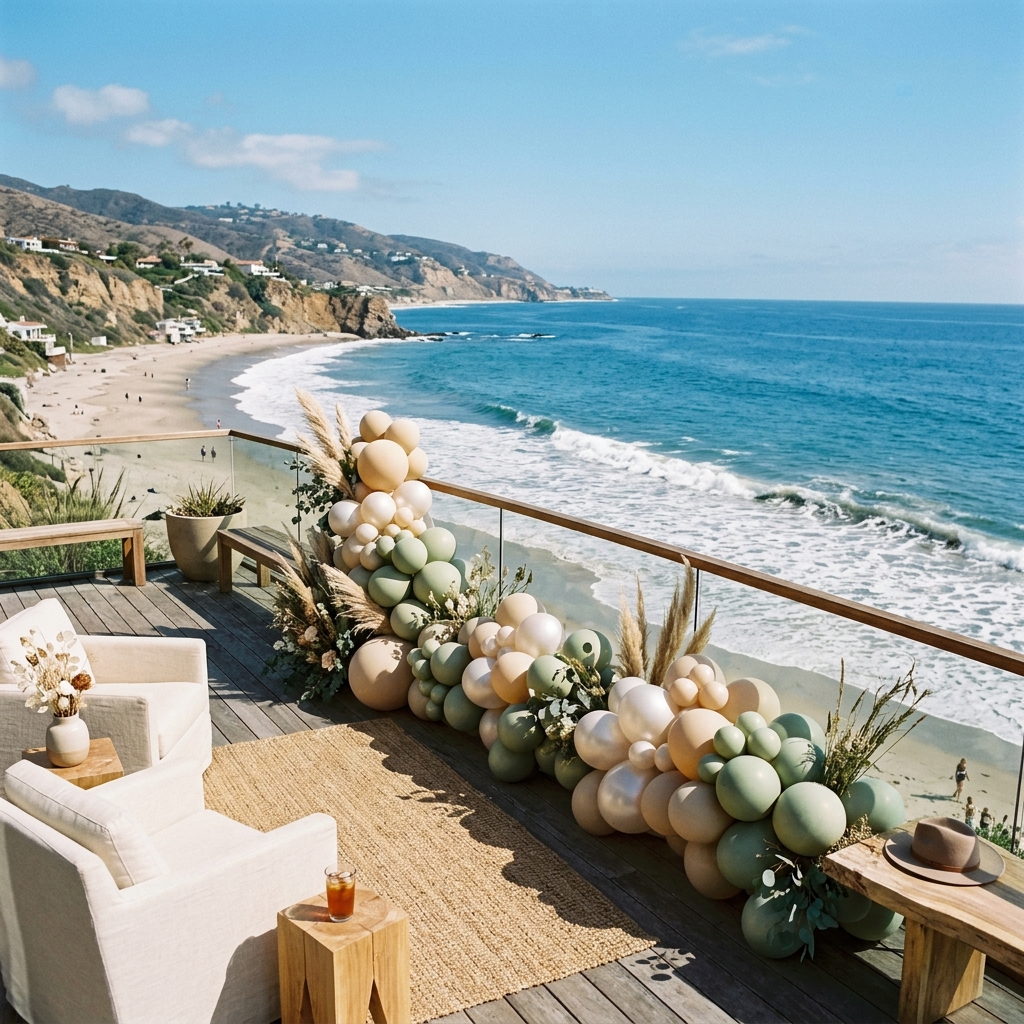
Figure 1: Wind-resistant low-profile organic balloon garland framing panoramic Pacific ocean views on a Malibu estate deck.
2. Ocean Breeze Wind Drag Physics & Ballast Calculations
Coastal breezes along Pacific Coast Highway (PCH) in Malibu routinely range from 12 to 22 knots (15 to 25 mph). A dense 20-foot balloon garland presenting a 40-square-foot surface area acts as a mechanical sail when wind strikes its surface. Without adequate ballast physics, wind drag will tip framing, bend conduit, or dislodge anchor points.
A. Calculating Structural Surface Drag Force
Aerodynamic force ($F_d$) acting on an organic balloon installation is calculated using the standard drag equation:
Fd = 0.5 × ρ × v2 × Cd × A
Where Fd represents total aerodynamic drag force (in Newtons), ρ (rho) is air density (1.225 kg/m3 at sea level), v is wind velocity in meters per second, Cd is the drag coefficient of organic spherical clusters (≈0.6), and A is total frontal surface area in square meters. In a 20 mph coastal gust, a 20-foot entrance arch experiences over 45 pounds of lateral force pushing against its frame.
B. Dual Steel Baseplate Ballasting Protocol
To counteract lateral wind force and prevent tipping, our installation team anchors all outdoor framing to dual heavy-duty powder-coated steel baseplates weighing 30 to 50 pounds per anchor leg. Baseplates are concealed beneath woven rugs, sandbags, or decorative floral planters, securing structural stability without compromising event aesthetics.
3. Outdoor Microclimate Performance Comparison Matrix
Logistical requirements vary significantly depending on the event's geographical distance from the Pacific ocean. The detailed matrix below compares environmental factors and prep requirements across three major Southern California outdoor zones:
| Outdoor Venue Microclimate | Primary Environmental Risk | Average Wind Velocity | Latex Prep Protocol | Ballast Standard per Anchor |
|---|---|---|---|---|
| Malibu Oceanfront Decks (PCH) | High salt air spray & persistent wind gusts | 15 – 25 mph | Double-stuffed + 15% Under-inflation + Low profile | 50 lb Dual Steel Baseplates + Sand Ballast |
| Santa Monica & Palisades Cliffs | Direct afternoon sun & moderate sea breezes | 10 – 18 mph | Double-stuffed + 10% Under-inflation + UV spray | 40 lb Dual Steel Baseplates |
| Pasadena & Inland Estate Lawns | Extreme heat (90°F–100°F) & solar radiation | 5 – 10 mph | Shaded setup + 15% Under-inflation + White tones | 30 lb Dual Steel Baseplates |
4. Thermal Gas Expansion & Charles's Law (10–15% Under-Inflation)
The single most common cause of balloon popping during outdoor summer events in Southern California is thermal gas expansion governed by Charles’s Law ($V_1 / T_1 = V_2 / T_2$).
When balloons are inflated in a cool morning workshop at 68°F and transported to an outdoor 88°F Malibu beach deck, the trapped air expands by approximately 8% to 12% in volume. If balloons were inflated to 100% capacity in the studio, thermal expansion stretches the latex membrane beyond its elastic tensile limit, causing immediate popping upon direct sun exposure.
The 10-15% Under-Inflation Rule
To eliminate popping risk, our studio strictly under-inflates outdoor balloons to 85%–90% of their maximum volume capacity. This leaves a 10% to 15% expansion safety buffer, allowing trapped air to expand safely without stressing latex walls.
5. UV Oxidation Management & Velvet Matte Transformation
Direct ultraviolet (UV) radiation from solar exposure initiates a natural chemical process known as latex oxidation. UV light breaks down the surface molecules of natural latex, transforming shiny, glossy balloons into a soft, velvety matte finish.
A. Embracing the Velvet Matte Aesthetic
In modern luxury event styling, velvet-matte oxidation is often considered highly desirable. Matte balloons absorb sunlight evenly, creating a sophisticated ceramic texture that photographs beautifully without glints or hotspots.
B. Preserving High-Gloss Closeness (HI-SHINE Treatments)
For events where clients specifically request high-gloss shine (such as metallic chrome gold installations), our team applies protective anti-oxidant silicone sprays (such as HI-SHINE) to balloon exteriors. This protective barrier seals the latex surface, preventing UV oxygen contact for 8 to 12 hours.
6. Salt Air Humidity & Double-Stuffing Durability
Oceanfront estates along Broad Beach, El Matador, and Carbon Beach in Malibu experience high ambient salt-air humidity. Salt micro-particles in coastal air can soften single-wall latex, increasing susceptibility to punctures from sharp coastal foliage or deck furniture.
Double-stuffing (nesting one balloon inside another) provides dual-wall puncture resistance. The outer latex membrane protects the inner inflated sphere from salt spray degradation, ensuring installations stay fully inflated across 12 to 14 hour outdoor celebrations.
7. Coastal Estate Case Studies
Our structural team has engineered outdoor installations across iconic coastal venues:
Broad Beach Malibu Estate Reception
For a 200-guest wedding reception on an open beach deck along Broad Beach, we engineered a 30-foot low-profile organic terrace garland. Utilizing double-stuffed cashmere nude, sand, and pearl white latex anchored to 50lb steel baseplates, the installation survived 22 mph afternoon wind gusts with zero popped balloons or frame movement.
Pacific Palisades Cliffside Gala
For a private estate gala overlooking the Santa Monica pier, we constructed a 20-foot entry arch exposed to 88°F afternoon sun. Under-inflated by 12% and treated with UV protection, the arch maintained perfect shape throughout the 10-hour event.
8. Comprehensive Outdoor Engineering FAQ (10 Q&A Pairs)
Q1: How do you secure balloon arches against strong ocean winds in Malibu?
A: Outdoor arches are secured using heavy 30 to 50 lb steel baseplates per anchor leg, low-wind drag aluminum conduit framing, and concealed ballast weights.
Q2: Why do balloons pop during outdoor summer events in Southern California?
A: Balloons pop due to thermal gas expansion (Charles's Law) when direct sun heats trapped air. Under-inflating by 10-15% provides expansion room and prevents popping.
Q3: Does ocean salt air damage latex balloons?
A: Salt air does not degrade natural latex chemistry, but double-stuffing is recommended to double wall thickness against coastal wind friction and humidity.
Q4: How far in advance can outdoor balloon decor be installed before guest arrival?
A: We recommend installing outdoor balloon decor 1.5 to 2.5 hours prior to guest arrival to minimize peak UV sun exposure time.
Q5: What balloon colors hold up best in direct California summer heat?
A: Light matte colors (white, ivory, cashmere nude, blush) reflect solar radiation best. Dark colors (navy, black, plum) absorb heat rapidly and require shade or maximum under-inflation.
Q6: Are balloon installations safe for windy oceanfront rooftop terraces?
A: Yes! We use low-profile organic designs anchored to heavy-duty steel baseplates that prevent tipping even in sustained 20 mph wind gusts.
Q7: What happens if it rains during an outdoor event in Santa Monica?
A: 100% natural latex balloons are completely water-resistant! Water droplets actually enhance balloon shine temporarily without damaging latex structure.
Q8: Can floating pool balloon clouds withstand ocean winds?
A: Yes. We anchor floating pool clouds using submerged stainless steel weights that keep installations stable and centered away from pool filter skimmers.
Q9: Are your outdoor framing systems safe for delicate estate deck surfaces?
A: Yes. All steel baseplates feature heavy non-marking rubber pads that protect teak wood, natural stone, and tile deck surfaces from scratches.
Q10: What deposit is required to reserve an outdoor installation date in Malibu?
A: We require a 50% deposit and signed agreement to lock in your date on our calendar, with the remaining balance due 7 days before setup day.
9. Book Your Outdoor Event Styling with The LA Balloonist
Planning an oceanfront wedding, cliffside gala, or beach estate celebration in Malibu, Santa Monica, or Pacific Palisades? Explore our Malibu Area Guide, view real outdoor installations in our Portfolio Gallery, or submit your details on our Consultation Request Form. Call our Burbank studio directly at (747) 305-7593.