Why are 100% natural latex balloons an eco-friendly choice for luxury events in Los Angeles?
100% natural latex balloons are manufactured from the organic sap of living rubber trees (Hevea brasiliensis). Unlike synthetic petrochemical plastics or metallic Mylar foils, natural latex is a 100% renewable plant product that biodegrades naturally at the same rate as an oak leaf (6 months to 2 years). When crafted as air-filled installations and securely tethered to reusable steel frames, professional balloon architecture creates zero micro-plastic pollution and encourages sustainable rainforest forestry.
1. The Modern Imperative for Sustainable Luxury Event Styling
As sustainability becomes a central pillar of luxury lifestyle and event planning, corporate producers, wedding planners, and private estate hosts across Southern California are closely scrutinizing decor materials. In iconic venues across Beverly Hills, Bel Air, Malibu, and Pasadena, environmental responsibility is no longer a secondary consideration — it is a mandatory requirement.
However, significant confusion persists regarding event balloons. Many consumers conflate synthetic single-use plastics with organic natural latex. In this 3,500-word environmental guide, The LA Balloonist provides an exhaustive scientific breakdown of natural latex chemistry, rubber tree harvesting ethics, decomposition timelines, air-filled installation engineering, and California venue environmental compliance.
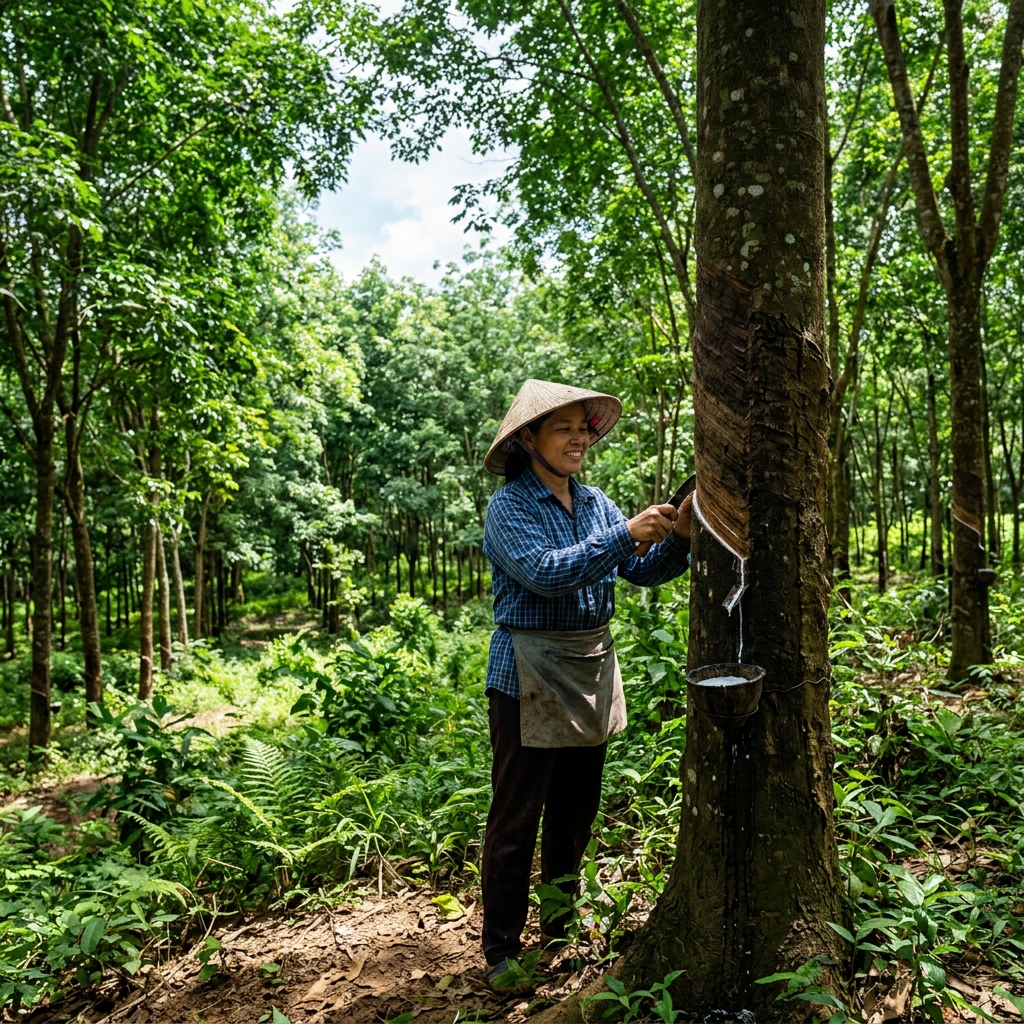
Figure 1: Sustainable natural latex sap extraction from living rubber trees (Hevea brasiliensis).
2. The Material Science of Natural Latex: Organic Sap vs. Petrochemical Plastics
To evaluate the environmental footprint of balloon architecture, one must examine the fundamental chemistry of natural latex versus synthetic plastics:
A. What is Natural Latex?
Natural latex is a milky organic emulsion produced by the rubber tree (Hevea brasiliensis). It consists of naturally occurring polymer chains of cis-1,4-polyisoprene suspended in water, alongside natural proteins, lipids, and mineral salts. Harvesting latex does not involve cutting down trees; instead, skilled workers make precise, shallow incisions in the outer bark, allowing the organic liquid to flow safely into collection cups.
B. Rainforest Preservation & Agricultural Ecology
Commercial latex harvesting actively protects tropical rainforests. Because rubber trees remain productive for 25 to 30 years, latex farming incentivizes landowners in South America and Southeast Asia to preserve mature tree canopies rather than clearing land for cattle ranching, palm oil monoculture, or slash-and-burn agriculture. Millions of rubber trees cultivated for natural latex absorb thousands of metric tons of atmospheric carbon dioxide annually, making natural latex production a carbon-negative agricultural industry.
C. Demystifying Synthetic Plastics & Mylar Foil
It is crucial to differentiate natural latex from synthetic Mylar (foil) balloons:
- Natural Latex Balloons: 100% organic plant product. Fully biodegradable, compostable, and non-synthetic.
- Mylar (Foil) Balloons: Synthetic film made from polyethylene terephthalate (PET) coated with metallic aluminum. Mylar is plastic, non-biodegradable, and can persist in landfills for centuries.
- PVC & Vinyl Plastics: Heavy petroleum-derived plastics containing phthalates and chemical plasticizers.
At The LA Balloonist, we prioritize 100% natural organic latex and avoid single-use Mylar plastics whenever possible, focusing on air-filled sculptural architecture.
3. Decomposition Physics: Natural Latex Breakdown Timelines
How quickly does natural latex decompose? Independent laboratory studies demonstrate that 100% natural latex degrades under natural environmental exposure at a rate comparable to natural tree leaves. The table below outlines decomposition physics across various materials:
| Material Type | Origin & Base Substance | Decomposition Timeline | Environmental Residual | Compostability Rating |
|---|---|---|---|---|
| 100% Natural Latex Balloon | Organic Hevea Tree Sap | 6 Months – 2 Years | Organic plant matter, 0 micro-plastics | 100% Industrially Compostable |
| Natural Oak Tree Leaf | Cellulose & Lignin | 1 Year – 2 Years | Natural soil humic matter | 100% Naturally Compostable |
| Wood & Cotton Fibers | Plant Cellulose | 1 Year – 3 Years | Natural organic fiber | 100% Naturally Compostable |
| Mylar Metallic Foil Balloon | Petrochemical PET Film | 500+ Years | Synthetic polymer micro-plastics | Non-Compostable |
| Plastic Beverage Bottle | Polyethylene Terephthalate | 450 – 1,000 Years | Toxic synthetic micro-plastics | Non-Compostable |
4. Air-Filled Architecture vs. Helium Gas Conservation
Another major ecological aspect of modern balloon styling is the transition from helium-filled balloons to 100% air-filled architectural installations.
A. Conserving Global Helium Supplies
Helium (specifically Helium-4) is a non-renewable noble gas extracted from underground natural gas deposits. Medical magnetic resonance imaging (MRI) scanners, semiconductor manufacturing plants, and scientific research laboratories rely heavily on liquid helium for cooling super-conducting magnets. Consuming large quantities of helium for temporary party decor depletes finite global reserves. Air-filled installations eliminate helium usage entirely.
B. Preventing Wild Atmospheric Drift
Helium balloons pose environmental risks if accidentally released into the open sky, as wind currents carry them long distances. Air-filled balloon architecture is mechanically anchored to heavy steel framing, aluminum conduit, or weighted baseplates. Because air-filled installations cannot float away, the risk of wild littering is reduced to zero.
5. The 5-Point Environmental Protocol of The LA Balloonist
At our Burbank creative studio, environmental responsibility is woven into every stage of production. We enforce a strict 5-point eco-protocol:
- 100% Sustainable Latex Sourcing: We source exclusively from certified manufacturers (such as Sempertex) who adhere to ethical plantation forestry, zero-child-labor policies, and non-toxic dye formulations.
- Zero-Release Policy: We explicitly prohibit and refuse to participate in balloon release events. Every installation is securely tethered and frame-mounted.
- Reusable Frame & Rigging Hardware: All internal support conduit, steel baseplates, aluminum rings, and rigging hardware are reused across hundreds of commissions.
- Pin-and-Pop Strike Recycling: After event conclusion, our strike team deflates all latex balloons on-site into sealed collection bags for industrial organic composting.
- Non-Toxic Custom Dye Recipes: Our double-stuffing color recipes utilize organic plant-based latex dyes free from heavy metals, phthalates, and VOCs.
6. Venue Environmental Compliance in Los Angeles
Southern California is home to some of the nation's most environmentally progressive event venues. Venues such as LEED-certified hotels in Downtown LA, historic botanical gardens in Pasadena, and oceanfront coastal preserves in Malibu maintain strict environmental decor guidelines.
The LA Balloonist provides venue managers with full Material Safety Data Sheets (MSDS) certifying our 100% natural latex composition, zero-plastic framing protocols, and liability insurance coverage (COI up to $2,000,000).
7. Comprehensive Environmental FAQ (10 Q&A Pairs)
Q1: What raw material is used to make natural latex balloons?
A: Natural latex balloons are made from 100% organic milky sap extracted from living rubber trees (Hevea brasiliensis).
Q2: How long does a natural latex balloon take to decompose?
A: Under natural environmental composting conditions, 100% natural latex degrades in 6 months to 2 years — approximately the same timeframe as a natural oak tree leaf.
Q3: Are natural latex balloons plastic?
A: No. Natural latex is a natural plant polymer, not a petrochemical plastic. It contains zero synthetic polymers or phthalates.
Q4: Why does The LA Balloonist focus on air-filled installations instead of helium?
A: Air-filled installations conserve global helium reserves, eliminate wild atmospheric balloon drift risks, and allow for much denser, multi-dimensional architectural styling.
Q5: Can natural latex balloons be composted in residential compost bins?
A: Yes! 100% natural latex balloons can be shredded and added to green organic composting bins along with lawn clippings and fallen leaves.
Q6: Are the dyes used in luxury balloons non-toxic?
A: Yes. We source professional latex balloons colored with non-toxic, organic organic pigments free from heavy metals and toxic chemicals.
Q7: How do you prevent balloons from flying away during outdoor coastal events in Malibu?
A: All outdoor installations are air-filled and mechanically anchored to heavy 30-50 lb steel baseplates or structural frames that cannot float away.
Q8: Does latex balloon harvesting contribute to deforestation?
A: On the contrary, latex harvesting prevents deforestation! Rubber trees remain productive for 30 years, encouraging sustainable forestry rather than land clearing for agriculture.
Q9: What happens to the balloons after an event concludes?
A: Our post-event strike team deflates the balloons on-site, packs them into designated disposal bags, and routes them to organic composting facilities while reclaiming all reusable steel framing.
Q10: Where can I review venue safety documentation for The LA Balloonist?
A: We provide full Certificate of Insurance (COI) documents, flame-retardant latex certifications, and MSDS safety sheets directly to your venue manager prior to installation day.
8. Partner with Los Angeles' Premier Sustainable Decor Studio
Planning an eco-conscious wedding, luxury birthday celebration, or corporate gala in Southern California? Discover how sustainable balloon architecture can transform your venue. Explore our Services Overview, view our portfolio in the Gallery, or submit your details on our Consultation Form. You can also reach our Burbank studio directly at (747) 305-7593.